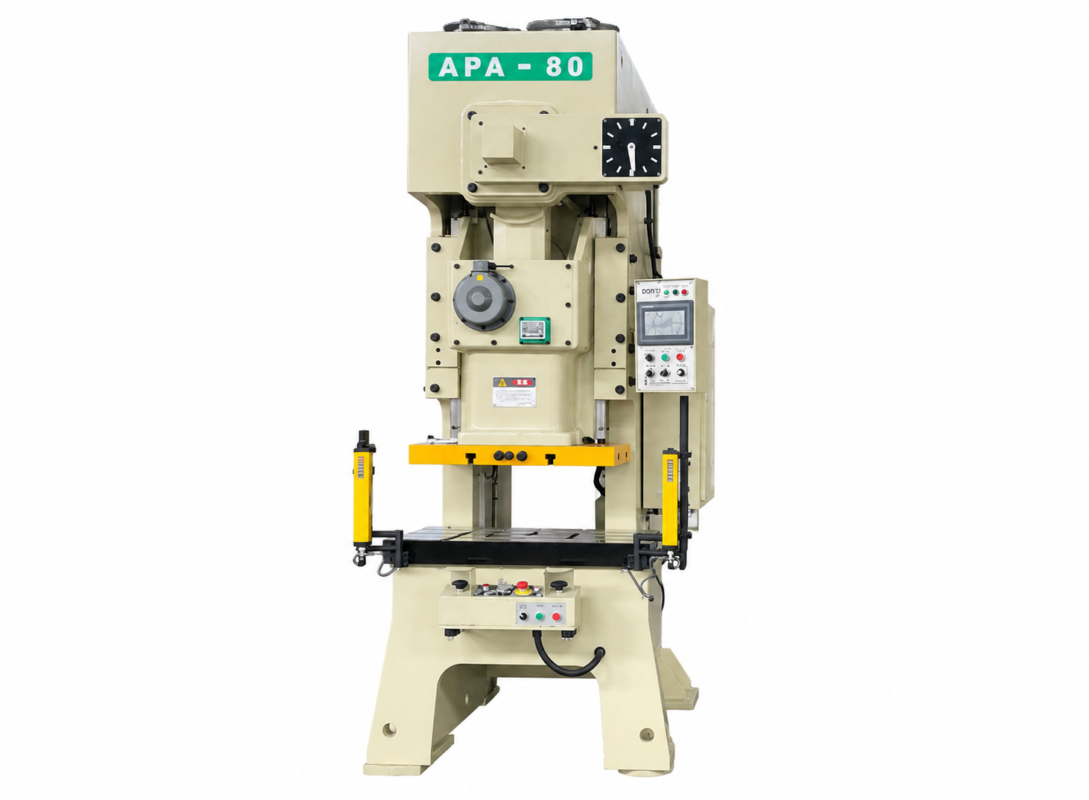
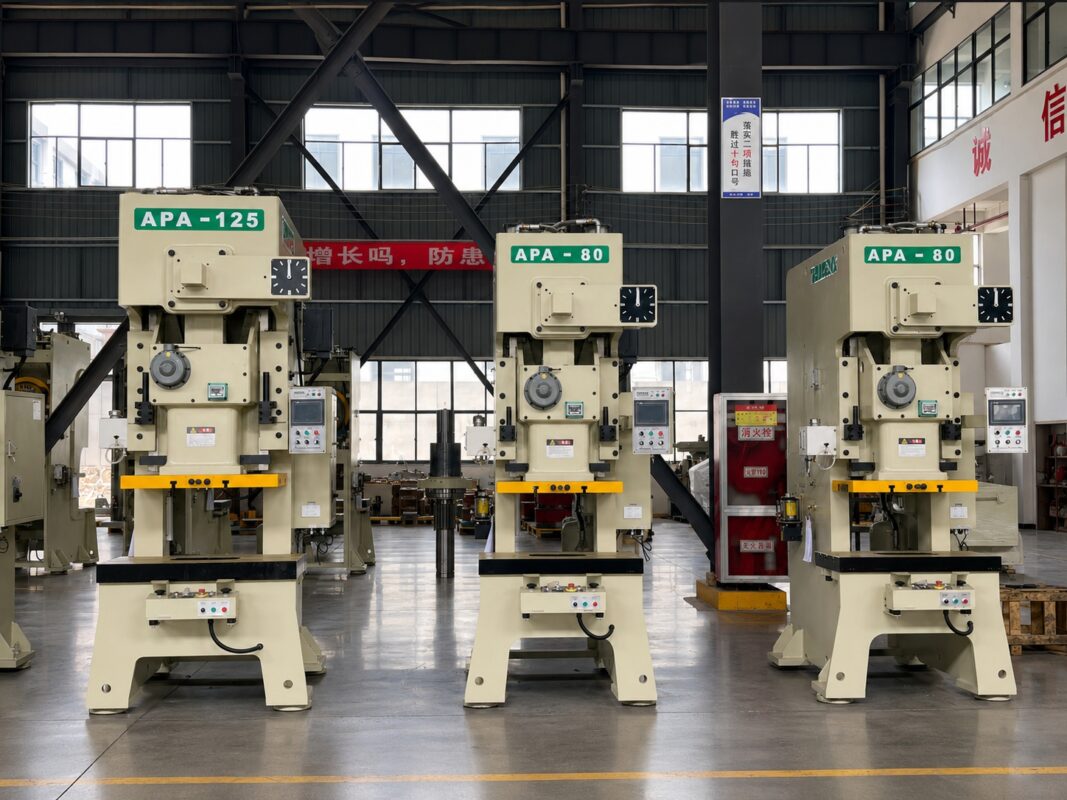
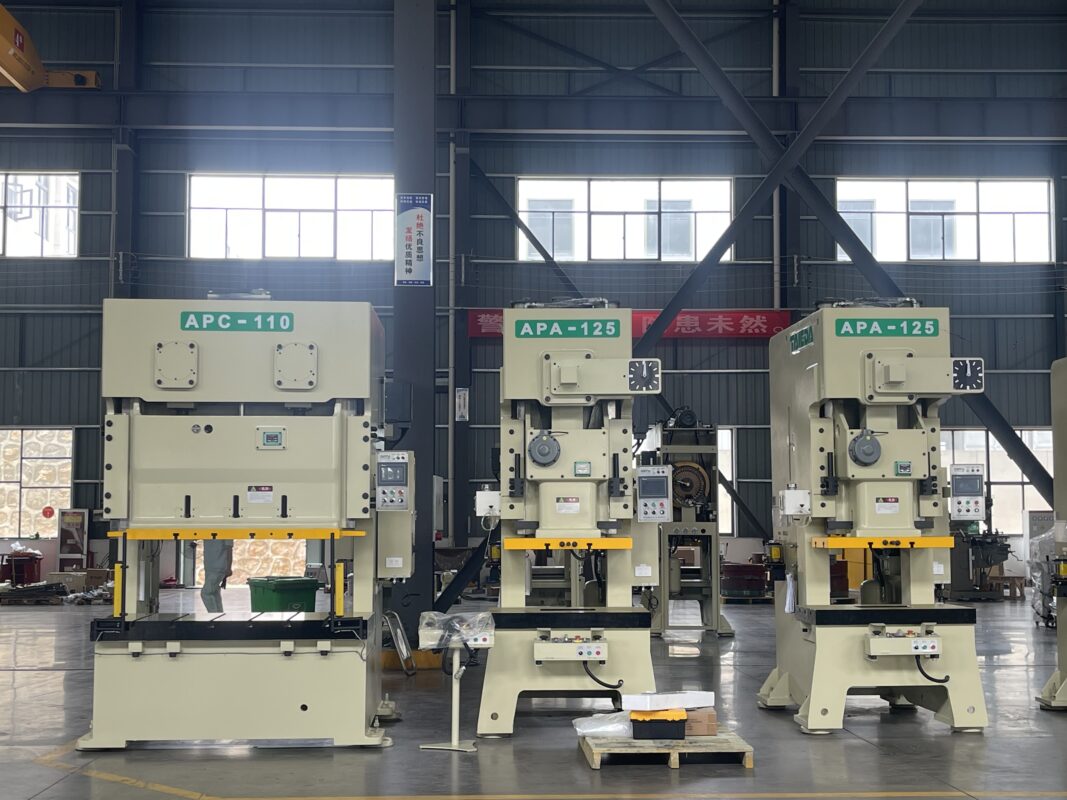
If your die is wider than the working table of a normal single-point press, you may need a two-point press. The main difference is simple: a single-point press drives the slide at one position, while a two-point press drives it at two positions.
But you should not choose a press by drive points alone. We also need to check your die size, required tonnage, stroke, production speed and load position.
1. What Is a Two-Point Press?
A two-point press drives the slide at two positions. These two positions are arranged across the slide to work with a wider table and a wider die.
“Two-point” refers to the number of drive points. “Double crank” refers to the drive structure. They do not always mean exactly the same thing, although they are often used together.
The DEYU APC Series uses a C-frame, double-crank and two-point structure. It is available from 110 to 315 tons.
2. Single-Point Press vs Two-Point Press
The main difference is the working width and drive structure.
If your die fits the APA working table, you may not need a two-point press. If your die is longer or wider, the APC Series may provide the working area you need.
Two presses with the same tonnage can have different table sizes, strokes and die spaces. This is why we do not recommend a press based only on tonnage.
3. When Should You Choose a Two-Point Press?
You should consider a two-point press when:
Your die is too wide for a suitable single-point press.
2. Your workpiece needs a wider working area.
3. Your die dimensions fit the APC working table better than the APA table.
4. You need a press within the APC range of 110-315 tons.
5. You want to connect the press with feeding equiment.
The load position also needs to be checked. If the load is not located near the center of the working table, send us the die drawing and load position before selecting the press.
4. Can It Work with an Automated Stamping Line?
The DEYU APC Series uses a closed-loop electrical control circuit. It can connect with feeders, decoiliers straighteners and other automation equipment.
If you plan to use coil material, we need to know the coil width, coil weight, material thickness, feed length and required production speed. We use this information to select the press and feeding equipment together.
The APC Series can be integrated into a progressive die stamping line when the press specifications match the die. This does not mean that every progressive die is suitable for every APC model.
5. What Information Should You Send Us?
Before we recommend a two-point press, please send us:
Part drawing
Material type and thickness
Required tonnage
Die length, width, height and weight
Required stroke
Required production speed
Load position
Coil width and coil weight, if coil material is used.
If you do not have all the information, send us the part drawing and available die details first. We can check the remaining items with you.
6. Frequently Asked Questions
Is a two-point press the same as a double-crank press?
Not always. “Two-point” describes the two drive positions, while “double crank” describes the crank structure. The DEYU APC Series uses both.
Do I need a two-point press for a wide die?
Possibly. We first compare the die dimensions with the working table and die space. Tonnage alone is not enough to make the decision.
Can the APC Series connect with a feeder?
Yes. The APC Series can connect with feeders, decoilers, straighteners and other automation equipment. The equipment must be selected according to your coil and production requirements.
Can the APC Series be used for progressive die stamping?
It can be used in a progressive die stamping line when the tonnage, table size, stroke, speed and feeding equipment match the die and material.
7. Conclusion
A two-point press is a practical option when your die requires more working width than a suitable single-point press can provide.
DEYU’s APC Series is a C-frame double-crank, two-point press available from 110 to 315 tons. It has a wider working table than the APA Series and can connect with automated feeding equipment.
Send us your part drawing, material thickness, die dimensions, required tonnage and production speed. We will check whether the APA or APC Series is more suitable for your stamping job.
Learn how metal stamping is used for new energy vehicle brackets, mounting plates and connecting parts, and what to check when selecting a press and feeding equipment.
Learn what information buyers should prepare before selecting a stamping press, including part drawings, material, die data, production speed and automation requirements.