What Is Progressive Die Stamping and How Does It Work
What Is Progressive Die Stamping and How Does It Work

Progressive die stamping uses one die with several stations. A coil strip moves through the die step by step, and each station completes a different operation. Once the line is running, a finished part can leave the final station with each press stroke.
If you need to produce the same metal part in medium or large quantities, this process may be a suitable choice. In this article, we explain how the process works, what equipment is normally used, and how you can choose a suitable stamping press for your die.
1. What Is Progressive Die Stamping
Progressive die stamping uses one die with several working stations. A metal strip moves through these stations step by step. Each station does one part of the work.
For example, the first station may make a hole. The next station may cut or bend the material. The final station separates the finished part from the strip.
You do not need a separate press for every step. The same press closes the die again and again while the feeder moves the strip forward.
2. How Does a Progressive Die Stamping Line Work
A progressive die stamping line moves coil material through the die in a fixed sequence. The press and feeding equipment must work together so the strip moves the same distance after every stroke.
A normal progressive die stamping line works like this:
– The decoiler holds the metal coil.
– The straightener makes the strip flat.
– The feeder sends the strip into the press.
– The press closes the die and completes several operations at the same time.
– The feeder moves the strip forward, and the next press stroke begins.
– The finished part leaves the die at the final station.
After the line is set up, this process repeats automatically. That is why progressive die stamping is commonly used for continuous production.
The feed length must match the distance between the die stations. This fixed distance is often called the feed pitch. If the strip does not move to the correct position, the next operation may not line up with the previous one.
Once the strip has filled all die stations, the final station can produce a finished part with each press stroke. Before production starts, the press, feeder and die should be tested together at a safe speed.
3. What Operations Can Be Completed in the Die
A progressive die can complete several operations while the strip moves through the stations. The exact sequence depends on your part design.
| Operation | What it does |
| Punching | Makes holes in the strip |
| Cutting | Removes material or creates an outline |
| Bending | Bends the material at the required angle |
| Forming | Creates the required shape or feature |
| Cut-off | Separates the finished part from the strip |
4. Why Do Manufacturers Use This Process
If you need stable output and repeatable parts, progressive die stamping is a good fit. Feeding and stamping take place in one line, so less manual movement is needed between separate machines.
The main benefits are:
– Several operations can be completed in one die
– Parts can be produced continuously from coil material
– The production process is easier to repeat consistently
– The press can work with automatic feeding equipment
5. What Parts Can You Produce
You can use progressive die stamping for many small and medium metal parts. Common examples include brackets, clips, terminals, connectors, electrical parts, appliance parts and automotive components.
Before choosing this process, you should check the part shape, material, thickness and expected production quantity. The die maker also needs to confirm that the part can move through the stations without problems.
6. What Equipment Do You Need
Progressive die stamping line equipment normally includes the press, die and coil handling equipment. A basic line uses:
– A mechanical stamping press
– A progressive die
– A decoiler to hold and unwind the coil
– A straightener to flatten the strip
– A feeder to move the strip into the press
– Part and scrap collection equipment
You may also need a lubrication system or monitoring equipment. The final setup depends on your material, die and production requirements.
7. When Is Progressive Die Stamping a Good Choice
Progressive die stamping is a practical choice when you need to produce the same part repeatedly in medium or large quantities. It is also useful when several punching, cutting, bending or forming steps can be completed while the strip stays inside one die.
For a small order, the tooling cost may be too high compared with a simple single-operation die. Large parts or parts that require complex deep drawing may also need another die structure or a different type of press. We recommend checking the part and die before deciding on the process.
8. How Do You Choose a Progressive Die Stamping Press
When you choose a progressive die stamping press, do not look at tonnage alone. You also need to check the die size, working table, stroke, production speed and load position.
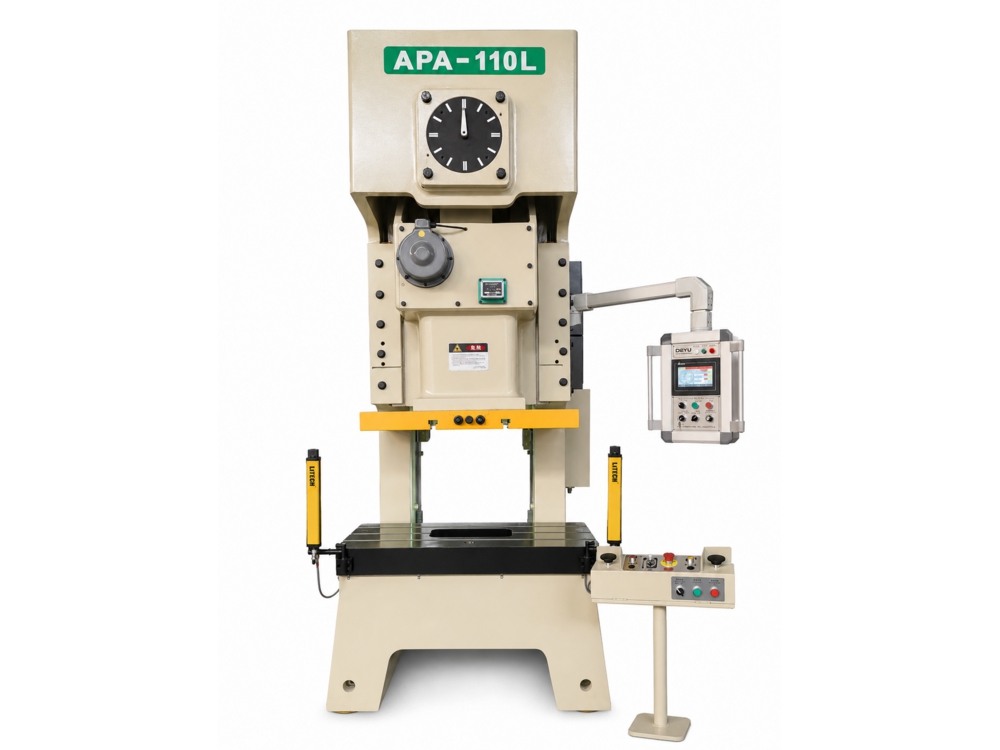
If your die is smaller and fits the working table, you may use a DEYU APA Series C-frame single-crank press. The APA Series covers 15 to 315 tons and uses a single-point structure.
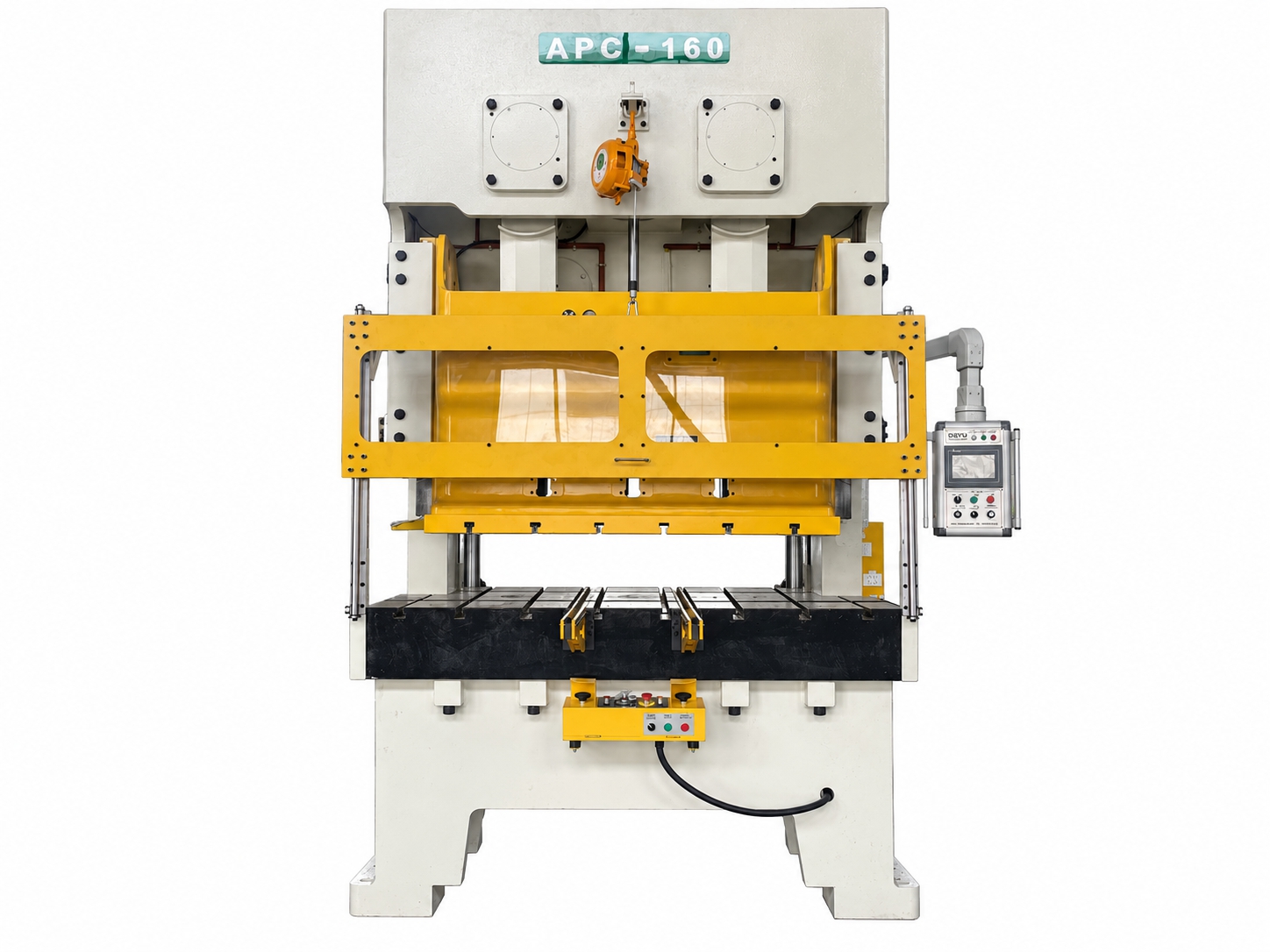
If your die is wider, the APC Series provides a wider working table and a two-point, double-crank drive. The APC Series covers 110 to 315 tons and can be more suitable for a long die.
For a large die or a job that needs more frame support, we may recommend an APF frame-type press or an APE straight-side press. The APE Series covers 110 to 800 tons.
The feeding equipment must also match the coil width, coil weight and material thickness. When selecting a press, we also check whether it can work properly with the feeding equipment used in your production line.
9. What Information Should You Send Us
For a progressive die stamping project, we need more than a requested tonnage. To recommend a suitable stamping press, we normally need:
– Your part drawing
– Material type and thickness
– Die size and weight
– Required press tonnage
– Required stroke and production speed
– Coil width and coil weight
– Expected production quantity
If you do not have all the information, send us the part drawing and the available die details first. We can review them with you step by step.
10. Frequently Asked Questions
What is progressive die stamping
Progressive die stamping is a process in which a metal strip moves through several stations inside one die. Each station completes one operation, such as punching, cutting or bending, until the finished part is separated from the strip.
What equipment is needed for progressive die stamping
A typical line includes a mechanical press, a progressive die, a decoiler, a straightener and a feeder. You may also need lubrication, part collection and scrap collection equipment, depending on the product and material.
How do I choose a progressive die stamping press
You should check the required tonnage, die dimensions, working table size, stroke, production speed and load position. We also check whether a single-point, two-point, frame-type or straight-side structure is more suitable for your die.
Is progressive die stamping suitable for small orders
It may not be the most economical choice for a small order because the progressive die normally requires a higher initial investment. The best choice depends on the part, die complexity and expected production quantity.
11. Conclusion
Progressive die stamping helps you complete several operations in one continuous process. After the strip fills the die stations, a finished part can leave the final station with each press stroke.
The press, die and feeding equipment must work together. Send our your part drawing, material thickness, die dimensions and required production speed. We will help you choose a suitable press and feeding line for your production.